
Chronic wounds · 30 days and counting
A wound that hasn’t closed in a month doesn’t need more time. It needs a different plan.
Coastal Wound Care is a physical therapy practice built around the wounds that stall — venous, arterial, diabetic, and pressure-related ulcers that have outlasted conservative care. We combine low-frequency ultrasound therapy, skilled wound management, and the strength and mobility work that keeps a healed wound from coming back.
Hollister, California · In-clinic and in-home · Medicare Part B and self-pay
Illustrative of our measurement cadence, not outcome data. Every wound is measured, photographed, and staged at each visit. If the trajectory flattens, the plan changes — we do not keep repeating a treatment that isn’t moving the wound.
Days of failed conservative care before advanced modalities apply
Doctor of Physical Therapy, trained at George Washington University
Offices — Hollister, Watsonville, San Jose — plus visits at home
Our 30-month wound recovery protocol study opens to patients
What we do
Three problems we were built to solve
Every patient here arrives after something else stopped working. That is the common thread, whether the problem is an open wound, a fall, or pain that has outlived its injury.
Advanced wound care
Chronic wounds older than 30 days with a vascular or pressure origin, treated with low-frequency ultrasound therapy, skilled debridement-adjacent care, offloading, and edema control.
How it worksBalance & neuro recovery
Overhead-track harness training that lets you attempt stairs, curbs, and obstacle courses at full effort. Post-stroke, vestibular, neuropathic, and post-concussion recovery.
Inside the Solo StepChronic pain & scar tissue
Hands-on myofascial release and instrument-assisted soft tissue work for restrictions that have quietly rewritten how you move.
Our approachLow-frequency ultrasound therapy
Sound waves where a scalpel would be intolerable
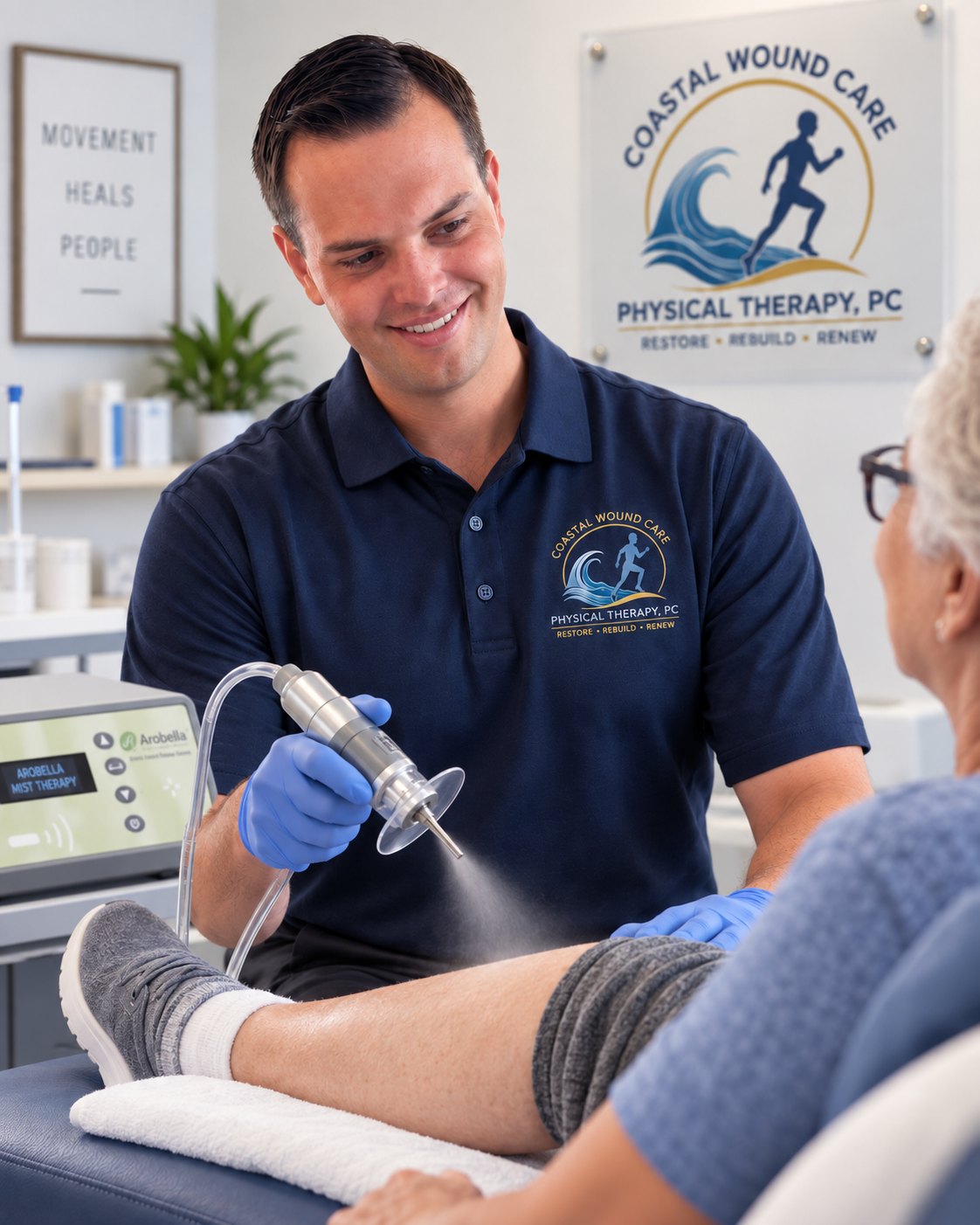
Low-frequency, non-contact ultrasound delivers ultrasonic energy to the wound bed through a fine saline mist. The applicator never touches the tissue. It is used to loosen devitalized tissue and slough, reduce bacterial burden in the wound bed, and stimulate the cellular activity that stalled wounds have lost — without the pain that makes sharp debridement impossible for many patients.
- Non-contact and generally well tolerated, including on painful ulcers
- Delivered as part of a full plan of care, not as a stand-alone gadget
- Reassessed on a fixed schedule — treatment continues only while the wound responds
The Solo Step overhead track
Permission to try the thing you’re afraid of
Fear of falling is its own diagnosis. It shortens stride, stiffens posture, and quietly removes stairs, curbs, and uneven ground from a person’s life. Our ceiling-mounted Solo Step track runs the length of the gym and carries a body-weight harness, so a patient who is genuinely at risk can attempt a real stair, a real curb, a real obstacle course — and cannot hit the floor.
That single change turns cautious, hand-held shuffling into honest, full-effort training. Strength, coordination, and confidence follow, because the nervous system is finally allowed to practice at the edge of ability instead of well inside it.
Installed at our Hollister clinic, opening January 2027.
Conservative care — dressings, offloading, compressionDay 30 · the escalation point
Who qualifies
Advanced wound modalities are reserved for wounds that have failed appropriate conservative treatment for more than 30 days. That threshold is clinical, not administrative — it separates a wound that is healing slowly from one that is not healing at all.
What it costs
Medicare Part B is the payer that reliably covers low-frequency ultrasound therapy. Most commercial plans still classify it as investigational. We are out of network with commercial insurers and publish clear self-pay rates.
Where we treat
In our Hollister clinic, or in your home. With a physician’s order for ultrasound therapy, we can bring advanced wound care and physical therapy to homebound patients who are not currently under a home health agency’s care.
Complexity is the point
Most of our patients arrive with more than one thing going on
Chronic wounds rarely travel alone. They come with diabetes and neuropathy, with vascular disease, with a history of stroke, with the deconditioning of a long hospitalization. Care that treats the wound and ignores everything around it tends to produce a wound that closes and reopens.
Dr. Bartges has spent his career working with medically complex patients — people on supplemental oxygen, with indwelling catheters, nephrostomy tubes, feeding tubes, or ostomies — and builds plans of care that account for all of it. Nothing about your equipment or your comorbidities disqualifies you here.
Commonly managed alongside
- Diabetes and peripheral neuropathy
- Venous insufficiency and lymphedema
- Peripheral arterial disease
- Post-stroke hemiparesis
- Supplemental oxygen dependence
- Foley and nephrostomy tubes
- PEG tubes and ostomy appliances
- Post-surgical deconditioning
Research & nutrition
We don’t just read the literature. We’re adding to it.
Beginning in early 2027, Coastal Wound Care will run a 30-month study developing an optimal advanced wound recovery protocol. Every eligible patient who gives informed consent can take part — and participation is entirely voluntary, with identical care either way.
A protocol study, not a marketing claim
The study is designed to test how modality selection, dosing, nutrition, and offloading interact in wounds that have already failed conservative care — the exact population most trials exclude.
Nutrition is treated as a wound intervention
Every patient is offered work with a licensed clinical dietitian. Protein and micronutrient targets are set from laboratory work the dietitian orders, not from a generic handout.
Where to find us
Three offices, one standard of care
Weekly wound care means a lot of driving. We put ourselves closer to you — and when travel still isn’t possible, we come to you instead.
San Benito County
Hollister
Opening January 2027
321 5th Street, Floor 1
Hollister, CA 95023
(831) 281-3328
Santa Cruz County
Freedom / Watsonville
108 Green Valley Road, Suite A
Freedom, CA 95019
(831) 281-3328
Santa Clara County
San Jose
5595 Winfield Boulevard, Suite 214
San Jose, CA 95123
(831) 281-3328
An independent physician practice led by Dr. Felix Huerta sees patients at all three offices Separate practices · separate billing
Questions people actually ask
Before you call
Do I need a physician’s referral?
For wound care, yes — low-frequency ultrasound therapy requires a physician’s order, and that order is also what allows us to treat you at home. For balance, orthopedic, and chronic pain rehabilitation, California allows direct access to a physical therapist for a limited period; Medicare still requires physician certification of the plan of care. We’ll walk you through exactly what’s needed.
Will Medicare cover this?
Medicare Part B covers medically necessary physical therapy and is the payer that reliably reimburses low-frequency, non-contact ultrasound therapy when documentation shows the wound failed conservative care and is responding to treatment. Coverage is never guaranteed in advance; we explain the rules plainly on our rates page.
What if I have commercial insurance?
We are currently out of network with all major commercial insurers. Many commercial plans also classify ultrasound wound therapy as investigational and will not pay for it regardless of network status. Self-pay is straightforward and priced transparently.
I’m already receiving home health. Can you still see me?
Not for the same services at the same time — Medicare does not pay twice for overlapping care. Our home visits are designed for the gap: patients who need skilled wound care and therapy but are not currently under a home health agency’s plan of care. Call us and we’ll sort out which applies.
Start with a conversation, not a form
Tell us about the wound or the fall, and we’ll tell you honestly whether we’re the right fit — and what your physician needs to send if we are.